You're reading an old forum thread, a gaming chat or a hacker movie script, and somebody types "j00 g07 pwn3d, n00b." Is that a typo? A secret code? Did their keyboard catch something?
Short answer: that's leetspeak, also written 1337 or l33t. It's a way of writing English that swaps letters for numbers and symbols that look similar, so "leet" becomes 1337 and "hacker" becomes h4ck3r. The word "leet" is short for "elite," and the style grew out of 1980s bulletin board systems, where being elite meant you had access to the good stuff.
So where did it come from, how do you read it, and does anyone still type like this without irony? Grab a decoder ring.
What Is Leetspeak?
Leetspeak is an alternative alphabet for English. You take normal words and replace some letters with characters that look like them: 3 for E, 4 for A, 0 for O, 7 for T, 1 for L or I. Sometimes you go further and build letters out of several symbols, like |-| for H or /\/\ for M.
There's no official standard. If the reader can decode it, it counts. That's half the fun, and half the point.
Leetspeak also comes with its own slang and grammar. Words get deliberately misspelled ("teh" instead of "the"), suffixes get bolted on ("pwnage," "h4x0r"), and certain typos became words in their own right. More on those in a minute.
What Does 1337 Mean?
1337 is "leet" written in leetspeak. Read it as letters: 1 is L, 3 is E, 3 is E, 7 is T. L-E-E-T.
And "leet" is a clipped version of "elite." Calling something 1337 means it's impressive, skilled or exclusive. Calling yourself 1337 means you think you're impressive, skilled or exclusive, which is a slightly different thing.
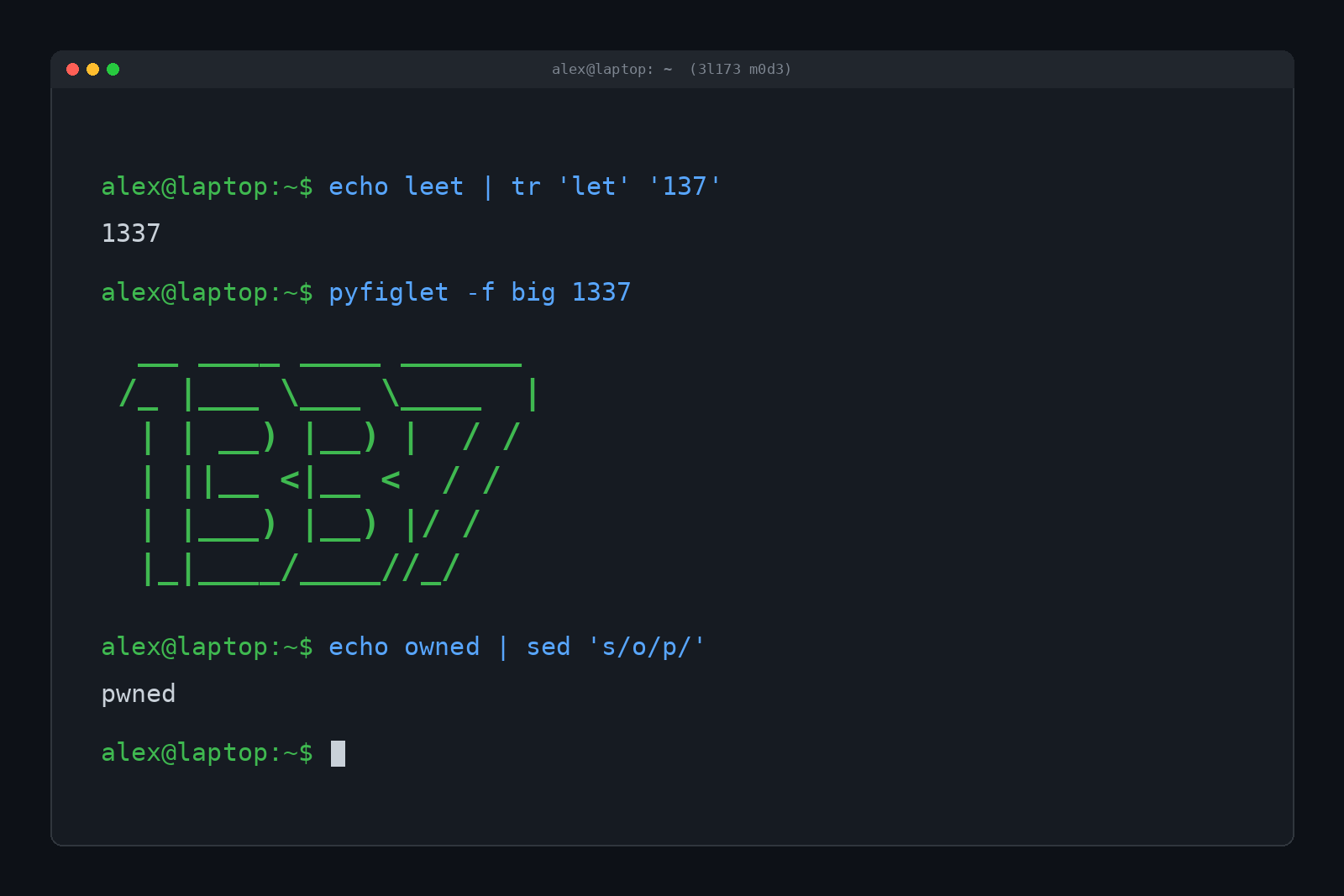
You can do the translation with tools that ship on basically every Linux and Mac machine. Here's real output from a terminal using tr, a command that swaps one set of characters for another:
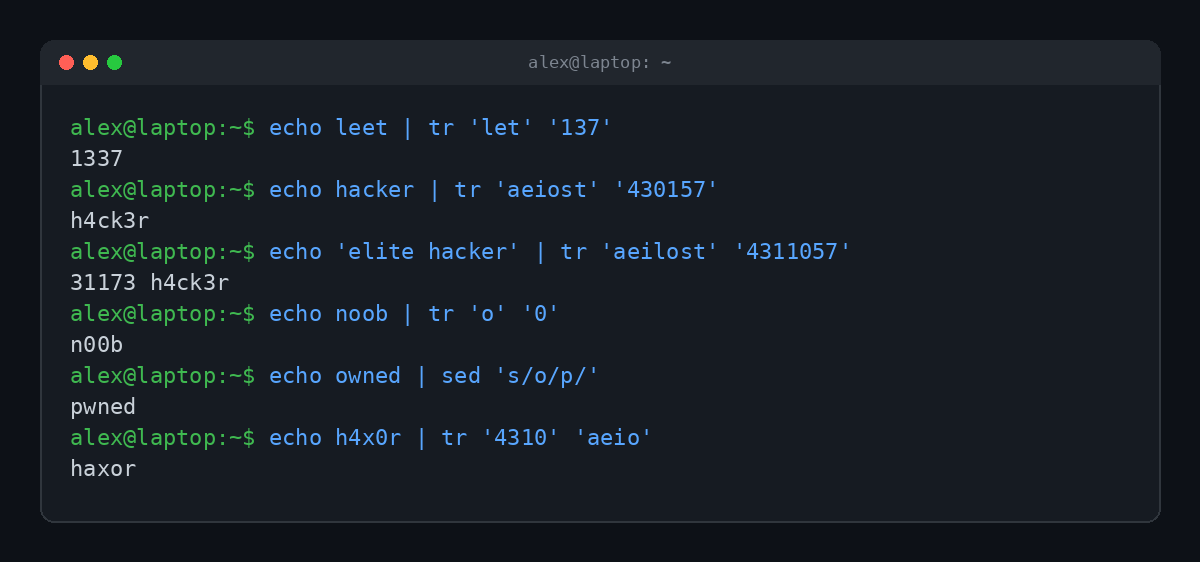
Notice the last line. Decoding h4x0r gives you "haxor," not "hacker." That's not a bug. Leet loves its own spellings, and "haxor" is the classic one.
Where Did Leetspeak Come From?
Before the web, people dialed into bulletin board systems (BBSes) with a modem. A BBS was basically one person's computer that strangers could call to post messages and swap files.
Many boards had levels of access. Regular users saw the public areas. Trusted users got "elite" status, which unlocked private file sections, games and chat areas. Elite turned into "eleet," then "leet," and the users who had it started showing off with a style of writing outsiders found hard to read.
A few things pushed the style along:
- Showing you belonged. Writing in leet signaled that you were in the club. If you couldn't read it, you weren't.
- Dodging filters. The popular theory is that some sysops (the people running the boards) and later IRC channels filtered words related to cracking, piracy and hacking. Spell them with numbers and the filter sails right past. That's plausible and widely repeated, but treat it as folklore, since nobody kept receipts.
- Hacker group text files. Groups like the Cult of the Dead Cow are often credited with spreading the term "leet" through their 1980s text files. That credit gets repeated a lot online, but solid dated evidence is thin, so file it under "probably, sort of."
Leet also had a famous cautionary tale. The Jargon File, the long-running dictionary of hacker slang, describes B1FF, a stereotypical clueless newbie who posted IN ALL CAPS with digit substitutions, piles of exclamation points and a giant signature. B1FF was a parody, and the joke was simple: if you use the style without the skill, you're not elite. You're B1FF.
The Leetspeak Alphabet
There are dozens of possible substitutions for every letter. These are the ones you'll actually see:
| Letter | Common leet | Fancier versions |
|---|---|---|
| A | 4, @ | /\, /-\ |
| B | 8 | |3, 13 |
| E | 3 | & |
| G | 6, 9 | (_+ |
| H | # | |-|, ]-[ |
| I | 1, ! | | |
| L | 1 | |_ |
| O | 0 | () |
| S | 5, $ | z |
| T | 7 | + |
| Z | 2 | 7_ |
Light leet just swaps vowels and a couple of consonants, which stays readable. Heavy leet builds every letter out of slashes and brackets, and turns a sentence into something closer to ASCII art. Which one you used said a lot about how much time you had on your hands.
Classic Leetspeak Words and What They Mean
Leet isn't just a font swap. It produced a whole vocabulary, and some of it escaped into everyday internet slang.
- n00b: a newbie. Usually not a compliment.
- pwned: beaten, dominated or hacked. The usual story is that it started as a typo of "owned," since P sits right next to O on a keyboard. We dug into that one in What Does Pwned Mean?
- h4x0r or haxor: a hacker, often used mockingly.
- w00t: a shout of joy. It's often said to stand for "we owned the other team," though that looks like a backronym invented after the fact.
- teh: "the," misspelled on purpose. Teh internet. Teh best.
- pr0n: you can probably work this one out. The swapped letters were a classic way to slip past filters.
- roxxor and sux0rz: "rocks" and "sucks," with the -xor suffix doing the heavy lifting.
That -xor ending works a lot like "-er" in normal English. Add it to a word and you get a person or thing that does it: haxor, pwnzor, roxxor. Leet grammar also happily turns nouns into verbs and adds -age for emphasis, which is how you get "pwnage" and "ownage."
When Leetspeak Went Mainstream
For a style built to keep outsiders out, leet has done remarkably well with outsiders.
In 2007, Merriam-Webster ran a public vote for its Word of the Year, and the winner was w00t, with two zeros. The press release described l33t as "an esoteric computer hacker language in which numbers and symbols are put together to look like letters." A dictionary picking a word spelled with zeros is a pretty clear sign the club had stopped being exclusive.
Then in 2015, the Collins Scrabble word list, the one used for competitive play in much of the English-speaking world, added pwn along with about 6,500 other new words, according to NPR. You can now legally pwn someone at Scrabble.
Gaming did the rest. Online shooters and MMOs in the 2000s were full of n00bs getting pwned, and that's where most people under 40 first met this stuff.
The Number 1337 Shows Up Everywhere
Once you know the joke, you start spotting it.
The most famous example is port 31337. That's "eleet" in leet, and it was the default port for Back Orifice, a remote control tool the Cult of the Dead Cow released at DEF CON 6 in August 1998. Security folks still recognize 31337 on sight, and it shows up all over capture the flag games and hacker in-jokes.
People also love writing 1337 in other number systems, partly as a puzzle and partly because it looks cool. Here's what it actually looks like, run for real:
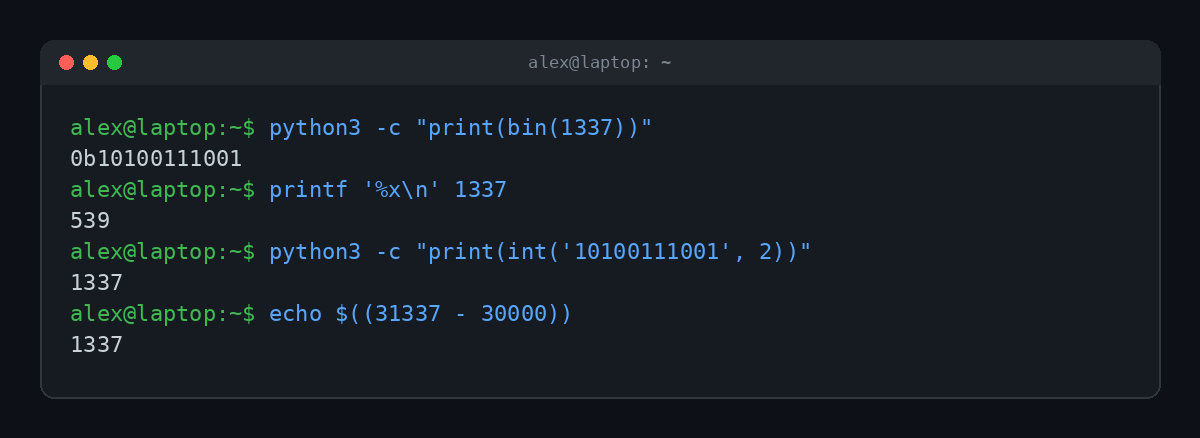
So if you ever see 10100111001 on a shirt or in a username, now you know. Somebody wanted you to work for it.
Is Leetspeak Still Used Today?
Mostly as a joke, a throwback or a username. Nobody serious writes whole paragraphs in heavy leet anymore, and doing it unironically is a bit like showing up to a meeting in a trench coat and mirrored sunglasses.
But the ideas behind it are very much alive:
- Usernames and gamertags. When "shadow" is taken, "5h4d0w" usually isn't.
- Hacker culture. Security conferences, CTF challenges and tool names still lean on 1337 references. If you're getting into that world, our post on how hackers get passwords covers one place leet still matters (keep reading).
- Filter dodging. The modern version is sometimes called algospeak: people swap letters, numbers or whole words to stop a social media algorithm from hiding their post. Different decade, same move as the BBS kids.
Are Leetspeak Passwords Secure?
This is where the trivia turns practical. Lots of people think P@55w0rd is clever. It isn't.
Password cracking tools have shipped with substitution rules for years. They take a dictionary word, then automatically try it with 4 for A, 3 for E, 0 for O, $ for S and so on. Swapping a few letters in a common word adds almost nothing, because the attacker's software is fluent in leet too.
What actually helps is length and randomness. A long passphrase of several unrelated words, or a random password from a password manager, beats any amount of clever leet. Save the 1337 for your gamertag.
FAQ
How do you pronounce leet?
Like "leet," one syllable, rhyming with "street." 1337 is read the same way, not "one thousand three hundred thirty seven."
Is leetspeak a real language?
Not really. It's a way of spelling English (and sometimes other languages) plus a pile of slang. Linguists would call it a writing style or a jargon rather than a language.
What does 1337 mean in gaming?
It means skilled or elite. Calling a play 1337 is a compliment. Calling yourself 1337 is asking for trouble.
Is there a leetspeak translator?
Plenty of websites do it, but one tr command in a terminal does the basics, as shown above. Decoding heavy leet by machine is harder, since there's no single right answer for each symbol.
What does n00b mean?
It's leet for "noob" or "newbie," someone who's new and still figuring things out. Everyone starts as one.
TL;DR
Leetspeak (1337) is English with letters swapped for look-alike numbers and symbols. It started on 1980s bulletin boards as a badge of "elite" status, gave the internet words like pwned, n00b and w00t, and still hides in usernames, port numbers and hacker jokes. Just don't use it for your passwords.