You lose a match and someone types "pwned" in chat. A week later you get an email saying your account showed up in a data breach, and the site that told you is called Have I Been Pwned. Same strange word, two very different bad days.
Short answer: pwned means owned. In games it means you got beaten, usually badly. In security it means hacked: someone took control of your account, your device or your data. It's a respelling of "owned," and the most likely reason it starts with a P is that P sits right next to O on a keyboard.
Here's where the word actually came from, how to say it without sounding weird, and what to do if your own accounts have been pwned.
Where "Pwned" Came From
Before anyone typed "pwned," hackers said "owned." In 1990s hacker culture, to own a computer meant you had full control of it, usually administrator or root access you were never supposed to have. A broken-into server was "owned." In leetspeak, the swap-letters-for-numbers style of early internet writing, it often showed up as 0wn3d.
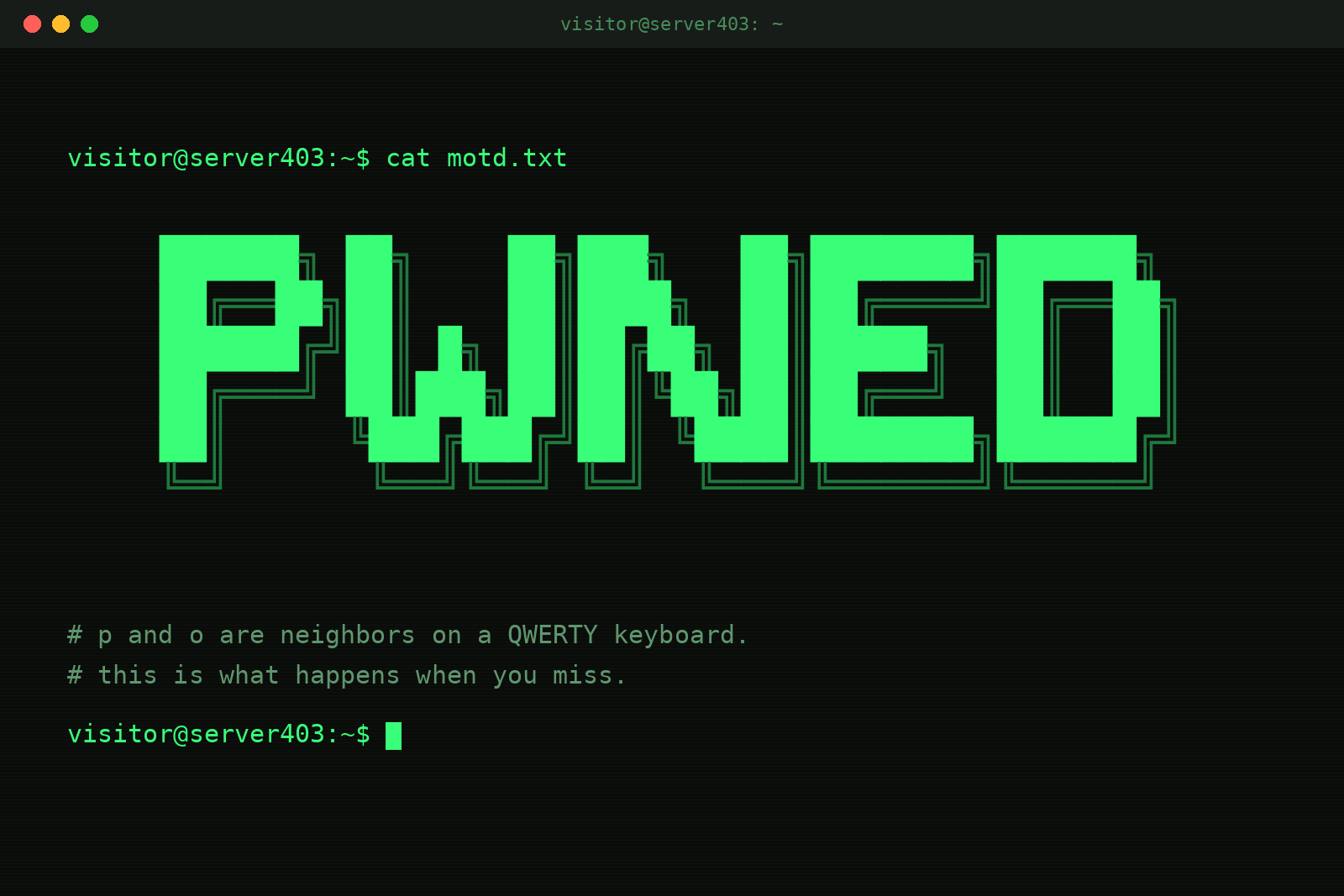
Then the P arrived. Merriam-Webster lists "pwn" as slang meaning "to dominate and defeat," and describes it as a respelling of "own," "probably originally from a typing error, p and o being adjacent letters on the QWERTY keyboard." The dictionary dates its first known use to 1999.
A typo that sticks around long enough stops being a typo. People started misspelling "owned" on purpose, because the mistake looked funnier and more smug than the real word.
The Warcraft story
You'll see a popular origin story repeated all over the internet: a map designer for the strategy game Warcraft supposedly misspelled a victory message, so the game announced that a player "has been pwned." It's a great story. Nobody has ever turned up a screenshot, a file or a credible source for it, so treat it as folklore. The keyboard explanation doesn't need a legend to work.
How it spread
By the early 2000s, "pwned" was everywhere in online games: shooter lobbies, MMO chat, Xbox Live trash talk. In 2004 a Canadian web series called Pure Pwnage, about a self-proclaimed pro gamer, launched and helped push the word even further into the mainstream.
Fun coincidence for the history nerds: the long-running hacker zine Phrack has long had a news section called Phrack World News, abbreviated PWN. It isn't where the slang came from, but it's hard not to appreciate the timing.
How Do You Pronounce Pwned?
There's no official answer, and people have argued about it for twenty years. The common versions:
- "Poned", rhyming with "owned." This is the one Merriam-Webster lists.
- "Powned", like "owned" with a P stuck on the front.
- "Pawned", like the pawn shop. Plenty of people say it this way, though it sounds like you sold your Xbox.
- "P-owned", spelling out the P, mostly said for effect.
- "Owned", because some people treat the P as silent, which is technically the most accurate option.
If you're ever unsure, "poned" is the safe choice. Nobody will correct you, and if they do, you've learned something about them.
The Pwn Family: Pwn, Pwnage, Pwnt and Friends
Once "pwned" caught on, the internet built a whole vocabulary around it:
| Word | What it means | Example |
|---|---|---|
| pwn | To beat, dominate or hack | "I'm going to pwn this level." |
| pwned / pwnd / pwnt | Beaten, owned or hacked | "That server got pwned." |
| pwn3d | Leetspeak spelling of pwned | "pwn3d, gg" |
| pwnage | An act of total domination | "That match was pure pwnage." |
| pwner / pwnz0r | The person doing the pwning | "Bow down to the pwnz0r." |
One thing "pwn" is not: an acronym. It doesn't stand for anything. Any website telling you otherwise is guessing.
Pwned in Gaming
In games, getting pwned means losing in a way that's a little embarrassing. Not a close match. The other player read every move, won easily and probably said so. "Get pwned" is the classic taunt, and "you just got pwned" is what the winner types while you're staring at the respawn timer.
These days it has a slightly retro feel, the online equivalent of saying something is "rad." It still shows up constantly, though, usually with a wink.
Pwned in Cybersecurity
In security, the word goes back to its hacker roots and gets serious. To pwn a system means to exploit a weakness in it and take control. If an attacker can run their own code on your laptop, read your email or log in as you, you've been pwned.
Security folks use it casually all the time. In capture-the-flag hacking competitions, "pwn" is the name of a whole challenge category: you're handed a program, and the goal is to find a memory bug and exploit it until you control what the program does.
Pwn2Own: hacking for prizes
The word even named the most famous hacking contest in the world. Pwn2Own started in April 2007 in Vancouver, alongside the CanSecWest security conference. Security researcher Dragos Ruiu came up with the idea partly to test the popular belief that Macs were much harder to hack than PCs.
The answer came on day two. Researcher Dino Dai Zovi found a flaw in QuickTime that could be triggered through Safari, and the exploit was used to take over a MacBook Pro. The prize was the laptop itself, plus $10,000 for the bug from the Zero Day Initiative, the bug bounty program that runs the contest today.
The idea is simple: if you can hack it, you win it. Pwn2Own has since awarded cash and devices for breaking into browsers, phones, smart home gear and even Teslas. Pwn2Own Berlin 2026 set a record, paying out $1,298,250 for 47 previously unknown bugs. Every flaw gets reported to the company that made the product so it can be fixed before details go public.
Have I Been Pwned
For most people, the word they actually run into is in the name of a website: Have I Been Pwned, or HIBP.
Security researcher Troy Hunt launched it on December 4, 2013, right after a huge breach at Adobe exposed more than 150 million accounts. Hunt found his own details in it and noticed the same people were getting caught in breach after breach. So he built one place to search across all of them. It launched with about 154 million accounts from five breaches.
It has grown a little since then. As of late October 2026, HIBP tracks more than 17.8 billion breached accounts from over 1,000 breaches. You type in your email address and it tells you which breaches it appears in and what kind of data leaked in each one, like passwords, phone numbers or home addresses. You can also sign up for alerts when your email shows up in a new breach. Tools like Mozilla Monitor and 1Password's Watchtower use HIBP's data behind the scenes.
How it checks your password without seeing it
HIBP also has a feature called Pwned Passwords that tells you whether a password has ever appeared in a breach. That sounds like a terrible idea: type your password into a website to see if it's been stolen. The trick is that it never actually receives your password.
Your password gets turned into a hash, a fixed-length fingerprint. Only the first five characters of that hash are sent to HIBP. The site sends back every leaked hash that starts with those five characters, usually somewhere between a few hundred and a couple thousand, and the matching happens on your own computer. HIBP never learns which one, if any, was yours. This approach is called k-anonymity.
Here's a real lookup for one of the most popular bad passwords on earth:
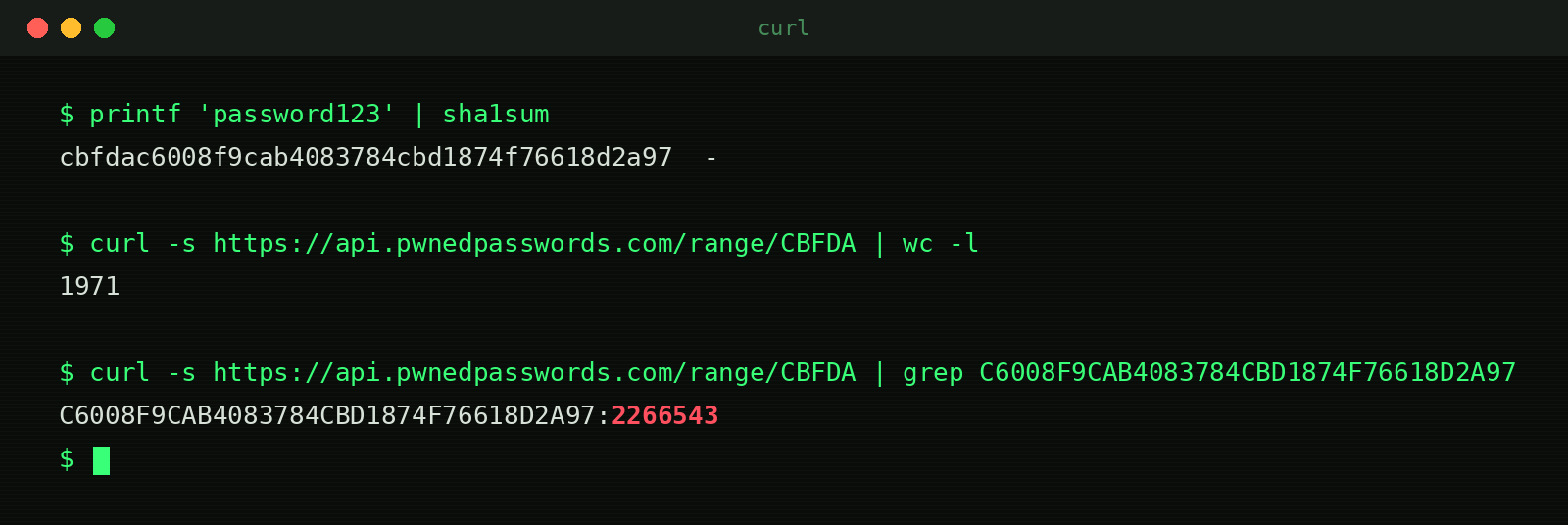
Over two million times. If you've been using it, it's time for a new one.
So You've Been Pwned. Now What?
Finding your email on HIBP is common. With billions of accounts in there, most people who've been online for a while are in at least one breach. It doesn't mean someone is in your accounts right now. It means some of your information is out there, and you should close the doors it could open.
- Check what leaked. HIBP lists the data types for each breach. A leaked email address alone is much less urgent than a leaked password.
- Change that password, and every place you reused it. Attackers take leaked email and password pairs and try them on other sites automatically. Reuse is what turns one breach into five.
- Turn on multi-factor authentication, or switch to passkeys where a site offers them. A stolen password alone is far less useful when it isn't enough to log in.
- Get a password manager. It makes a long, random, unique password for every account, so the next breach only costs you one.
- Watch for phishing. Scammers love breach data. Expect emails and texts that sound weirdly specific, and don't log in from links in them.
- Freeze your credit if financial details or your Social Security number leaked. In the US, freezing with Equifax, Experian and TransUnion is free and stops new accounts being opened in your name.
- Sign up for HIBP's free alerts so you hear about the next one right away.
If you want to know how passwords actually get stolen in the first place, and which habits shut most of those methods down, we break it down in How Do Hackers Get Passwords?
Frequently Asked Questions
Is pwned a real word?
Real enough. Merriam-Webster has an entry for "pwn" as slang, with a first known use in 1999. You still shouldn't put it in a cover letter.
What's the difference between owned and pwned?
They mean the same thing. "Pwned" is the internet spelling, and it comes with extra smugness built in.
Is "pwned" an insult?
It's teasing, not a slur. In games it's standard trash talk. In security it's just a blunt way of saying something got hacked.
Is Have I Been Pwned safe to use?
Yes. It's run by a well-known security researcher and used by companies and governments around the world. The email search never asks for your password, and the password checker uses the k-anonymity trick above, so your actual password never leaves your device.
What does pwn stand for?
Nothing. It's not an acronym, just "own" with a P where the O should be.
TL;DR
Pwned means owned: beaten in a game or hacked in real life. It started as hacker slang for taking control of a computer, picked up its P from a keyboard slip sometime around the late 1990s, and spread through online gaming in the 2000s. Today it names a world-famous hacking contest and the website that tells you which breaches your email has turned up in. If that's you, change your reused passwords, turn on MFA and let a password manager handle the rest.