You type a colon, a hyphen and a parenthesis. Your friend reads a smile. That's kind of amazing when you think about it: three random punctuation marks, tilted 90 degrees, doing the work of an entire facial expression.
Short answer: the first widely recognized digital emoticon, :-), was proposed by computer scientist Scott Fahlman on a Carnegie Mellon University online bulletin board on September 19, 1982, at 11:44 AM. He suggested :-) to mark jokes and :-( to mark things that weren't. People had played with punctuation faces before, but Fahlman's version is the one that caught on and spread across the early internet.
So why did a computer science professor need a joke marker? Who tried it before him? And how did three ASCII characters turn into thousands of emoji? Here's the whole story of who invented the emoticon.
Who Invented the Emoticon?
The credit for the modern emoticon goes to Scott Fahlman, a research professor at Carnegie Mellon University (CMU) in Pittsburgh. Guinness World Records lists his post as the first digital emoticon, and CMU itself celebrates it as part of the school's history.
The word emoticon is just "emotion" plus "icon." In practice, it means a face or feeling built out of regular keyboard characters. That's different from an emoji, which is a single picture character. More on that difference later, because it's a fun one.
The Elevator Joke That Started It All
In 1982, CMU's computer science department had online bulletin boards, sort of a group chat crossed with a message board, where people talked about everything from research to parking. The posts were plain text on terminals. No bold, no italics, and definitely no pictures.
In September of that year, a thread got going about physics in a falling elevator. What happens to a lit candle if the cable snaps? What about a drop of mercury? Then somebody posted a fake "WARNING!" saying one of the building's elevators had been contaminated with mercury from an experiment.
It was a joke. Some readers didn't take it as one. Others had to post corrections saying the warning wasn't real. A side conversation started: since sarcasm doesn't survive plain text, maybe jokes needed a label. People floated ideas like putting an asterisk or a special word in the subject line.
Then Fahlman posted this, under the subject line :-):
I propose that the following character sequence for joke markers: :-) Read it sideways. Actually, it is probably more economical to mark things that are NOT jokes, given current trends. For this, use :-(
That's it. That's the whole invention. The "read it sideways" part is what made it click: tilt your head left, and the colon is eyes, the hyphen is a nose and the parenthesis is a mouth.
The message that almost got lost
Here's the funny part. For about twenty years, nobody could prove that post existed. Plenty of people remembered it, but the bulletin board was long gone. In 2002, a group of CMU staff went digging through old backup tapes. Jeff Baird finally found and restored the thread from an October 1982 backup tape in September 2002, just in time for the smiley's twentieth birthday. The full thread is still posted on Fahlman's CMU page.
Why It Works: It's All Just ASCII
The reason :-) spread so fast is that it needed nothing special. Every computer and terminal in 1982 could type a colon, a hyphen and a parenthesis, because all three are part of ASCII, the 1960s standard that assigns a number to every basic character. (We break ASCII down in ASCII vs Unicode: What's the Difference?)
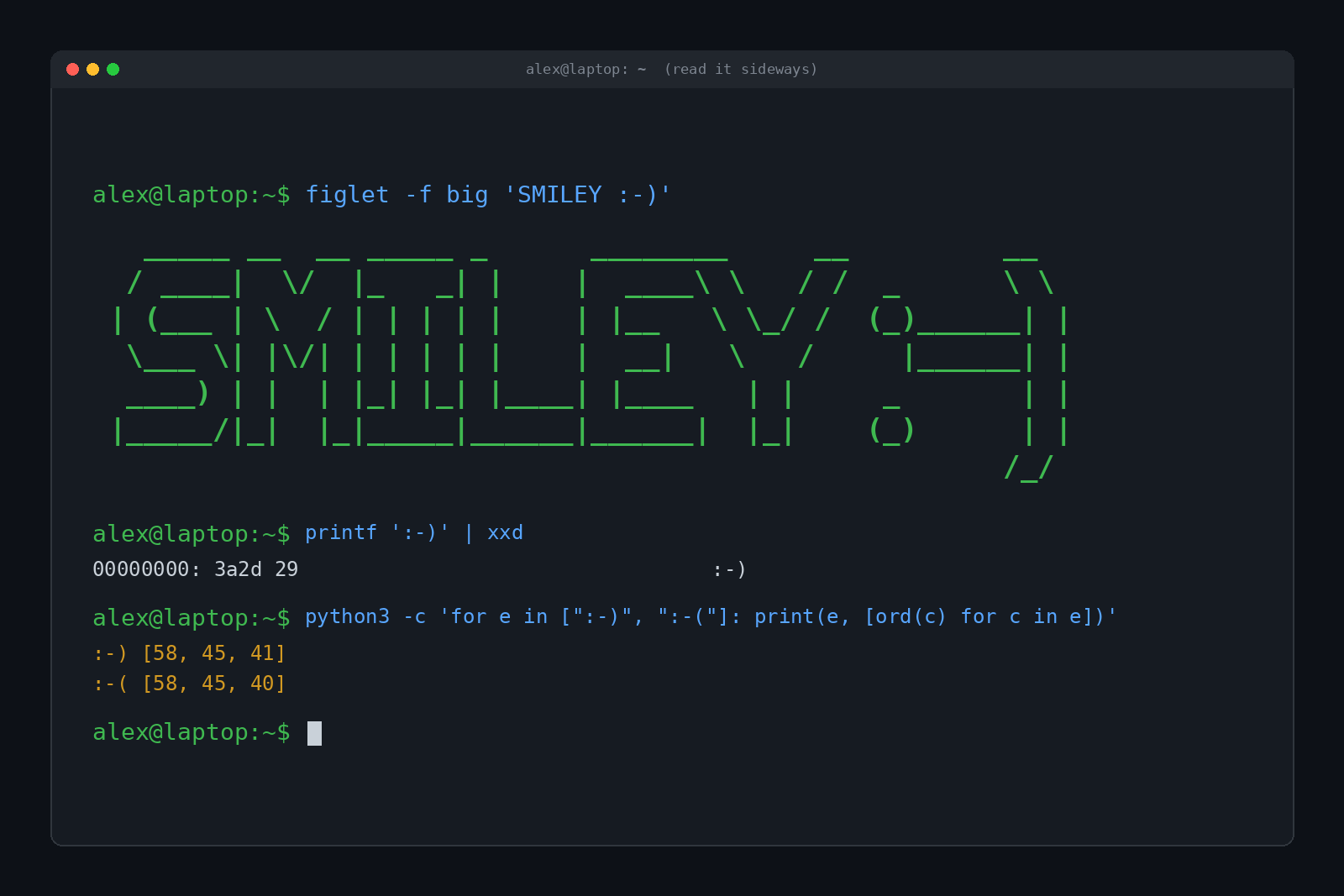
You can see this for yourself in a terminal. Every classic emoticon is just a handful of small ASCII numbers:
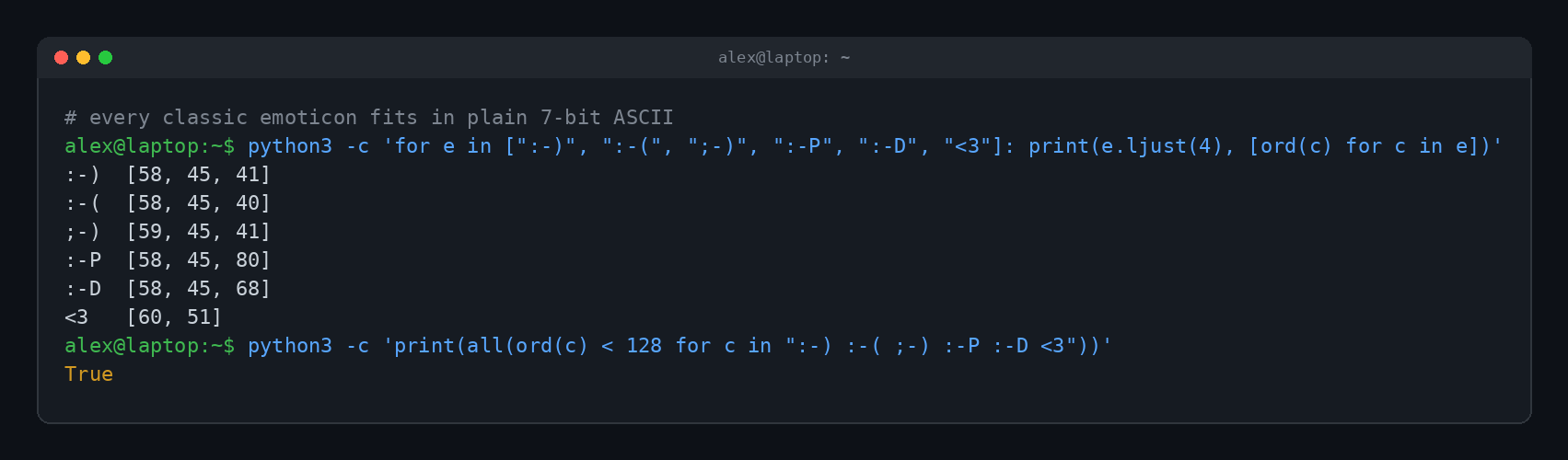
Notice that :-) and :-( differ by exactly one number: 41 versus 40. A smile and a frown, one bit of difference apart. The whole thing fits in three bytes, which mattered when network connections were measured in hundreds of characters per second.
Did Anyone Do It Before Fahlman?
Yes, sort of. People have been arranging punctuation into faces for a long time. Fahlman's version wasn't the first face, but it was the first one that stuck. Here are the main contenders:
- 1881, Puck magazine. The American humor magazine printed a bit called "Typographical Art," with four faces built from punctuation showing joy, melancholy, indifference and astonishment. They were standing upright, not sideways.
- 1887, Ambrose Bierce. The writer proposed a "snigger point," a mark shaped like a smiling mouth, to be added after jokes or ironic sentences. It never caught on.
- 1969, Vladimir Nabokov. Asked in an interview how he ranked himself among writers, he said he often thought there should be "a special typographical sign for a smile."
- 1979, Kevin MacKenzie. On ARPANET's MsgGroup mailing list, MacKenzie suggested
-)to mark a tongue-in-cheek sentence. People shrugged, and it faded away. Three years later, Fahlman added the eyes.
The folklore pile
A couple of "earlier emoticons" pop up online that don't really hold up. Treat these as folklore:
- Abraham Lincoln's winky face. A transcript of an 1862 Lincoln speech in the New York Times appears to contain
;)after "applause and laughter." Most people who've looked at it think it's a typesetting quirk or typo, not a wink. - A 17th century poem. A 1648 poem by Robert Herrick is sometimes said to contain
:). Language writers have pointed out that it's just a colon and a parenthesis used the normal way, and printing conventions of the time make it unlikely to be a face.
Fun to share. Not proof.
From Emoticons to Kaomoji to Emoji
Once :-) escaped CMU, it spread through mailing lists, Usenet and early online services. Variations piled up fast: ;-) for a wink, :-P for a tongue, :-D for a big grin, and the noseless :) for people in a hurry.
In Japan, people went a different way. Kaomoji ("face characters") like (^_^) are read upright instead of sideways, and they grew into wonderfully elaborate creations as Japanese text systems allowed more characters. That tradition eventually gave us internet classics like the shrug ¯\_(ツ)_/¯ and the table flip (╯°□°)╯︵ ┻━┻.
Then came emoji. In 1999, designer Shigetaka Kurita created a set of 176 tiny pictures for a Japanese mobile internet service. Emoji were later added to Unicode, the global character standard, so phones from different companies could show the same symbols. Today there are thousands.
Here's the technical difference, straight from the terminal:
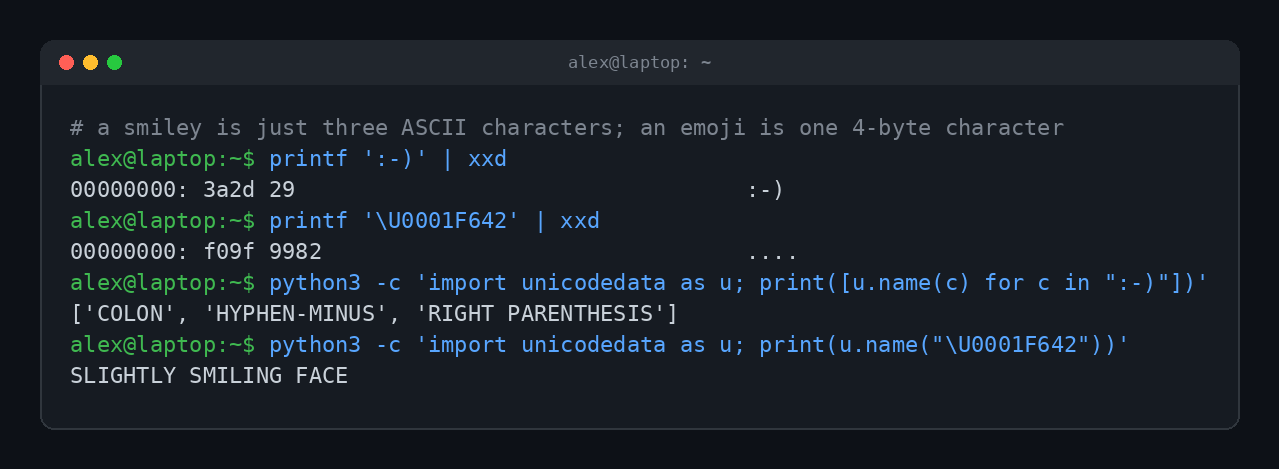
To a computer, :-) is a colon, a hyphen and a parenthesis that happen to sit next to each other. The emoji is a single character with an official name, "SLIGHTLY SMILING FACE." One is clever punctuation. The other is a built-in picture.
Why Emoticons Still Matter
Fahlman's original problem never went away. Text is terrible at tone. A dry joke and a real complaint look identical in a chat window. Emoticons and emoji are the patch we added on top, a little stage direction that says "I'm kidding" or "I'm sad" or "I'm being sarcastic."
The two worlds also blur together now. Lots of chat apps and phone keyboards quietly convert a typed :) into a smiley emoji the moment you hit space. So when you think you're sending three characters from 1982, the app may be sending one character from Unicode instead. Fahlman's idea still does the work, it just gets a costume change on the way out.
Emoticons also survive in places emoji don't. Code comments, terminal chat, plain-text email, commit messages and old-school forums still run on ASCII, so :-) works everywhere. And for a certain crowd, typing the nose is a quiet badge of honor.
Quick Answers
What was the first emoticon?
The first widely recognized digital emoticon is :-), proposed by Scott Fahlman at Carnegie Mellon University on September 19, 1982, along with :-(.
What is the difference between an emoticon and an emoji?
An emoticon is a face made from regular keyboard characters, like :-). An emoji is a single picture character defined in Unicode.
Why do you read emoticons sideways?
Because plain text runs left to right in a single line. Turning the face 90 degrees let a colon become eyes and a parenthesis become a mouth.
What does :-( mean?
It's a frown. Fahlman proposed it to mark posts that were not jokes.
Is it :-) or :)?
Both mean the same thing. The nose was in the original, and the noseless version came later because it's faster to type.
TL;DR
The emoticon as we know it was invented by Scott Fahlman at Carnegie Mellon on September 19, 1982, after a fake elevator warning on a campus message board fooled people. He proposed :-) for jokes and :-( for serious posts, and told everyone to read it sideways. Punctuation faces existed before, but his three ASCII characters were the ones that spread, eventually leading to kaomoji and modern emoji.