For years, the scary hacker in the movies was one person in a hoodie, typing very fast in a dark room. The FBI's latest warning is about something less cinematic and a lot more practical: a program where the "hacker" types one sentence, and a team of AI agents does the typing for them.
That program is called ARTEX.
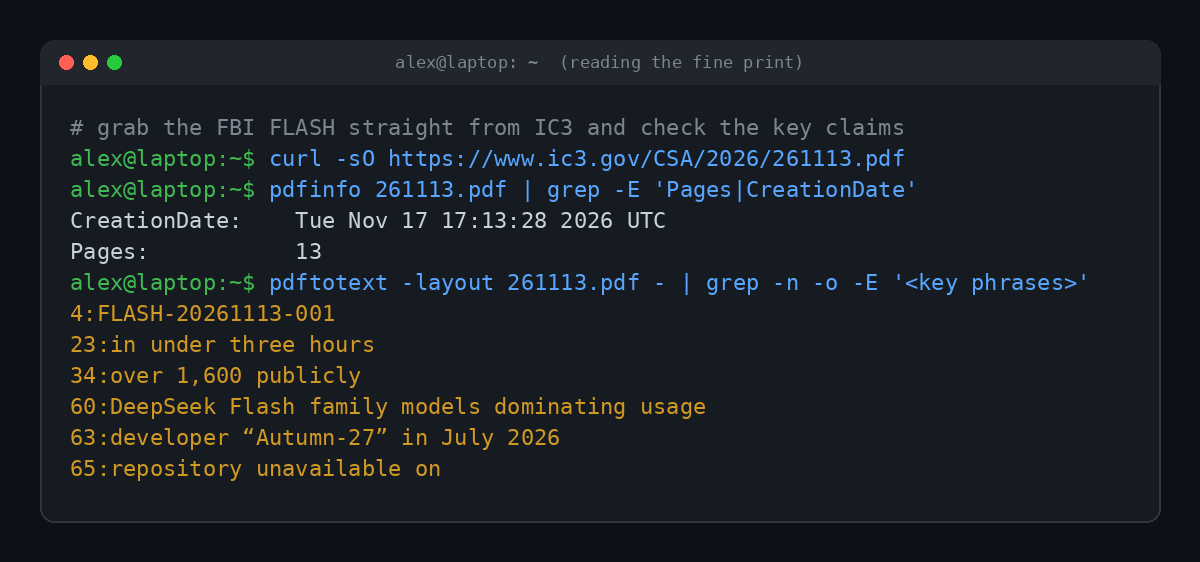
Short answer: ARTEX is an open-source, AI-driven penetration testing framework (a tool for simulating attacks) released on GitHub in July 2026. You give it a goal in plain language, and it hands the work to AI agents that scan, break in and move around a network with very little human help. It was pitched as a tool for authorized security testing, but on November 13, 2026 the FBI issued a FLASH alert saying criminals and state-linked groups have been using it for real attacks since at least August 2026, with some intrusions reaching admin-level access in under three hours.
So what exactly is it, why does the FBI care so much, and does any of this matter if you don't run a company network? Let's take it apart.
What Is ARTEX?
Strip away the headlines and ARTEX is a penetration testing framework. Pen testing is the legal, paid version of hacking: a company hires testers to attack its own systems and report the holes before real criminals find them. Tools for this have existed for decades.
What makes ARTEX different is the word the FBI keeps using: agentic. An AI agent is a program that doesn't just answer a question, it takes actions, looks at the results, and decides what to do next on its own. According to the FBI's FLASH alert (FLASH-20261113-001), ARTEX "translates high-level tactical goals described in natural language into actionable machine commands" run by specialized agents, needing "minimal human interaction beyond initial objective setting."
A few facts straight from the advisory:
- It's written in Go and runs as a web console.
- It has no AI model of its own. It plugs into outside large language model (LLM) services, including big names like Claude and GPT and models such as DeepSeek, GLM, Grok and Kimi.
- Attackers mostly pick cheap models. On attacker-controlled setups the FBI saw Chinese-origin models most often, with DeepSeek's Flash family "dominating usage," which it put down to low cost and a lack of guardrails when requests are framed as pen testing.
- It spread fast. The FBI estimates it reached 1,500 to 2,000 GitHub stars within 10 weeks.
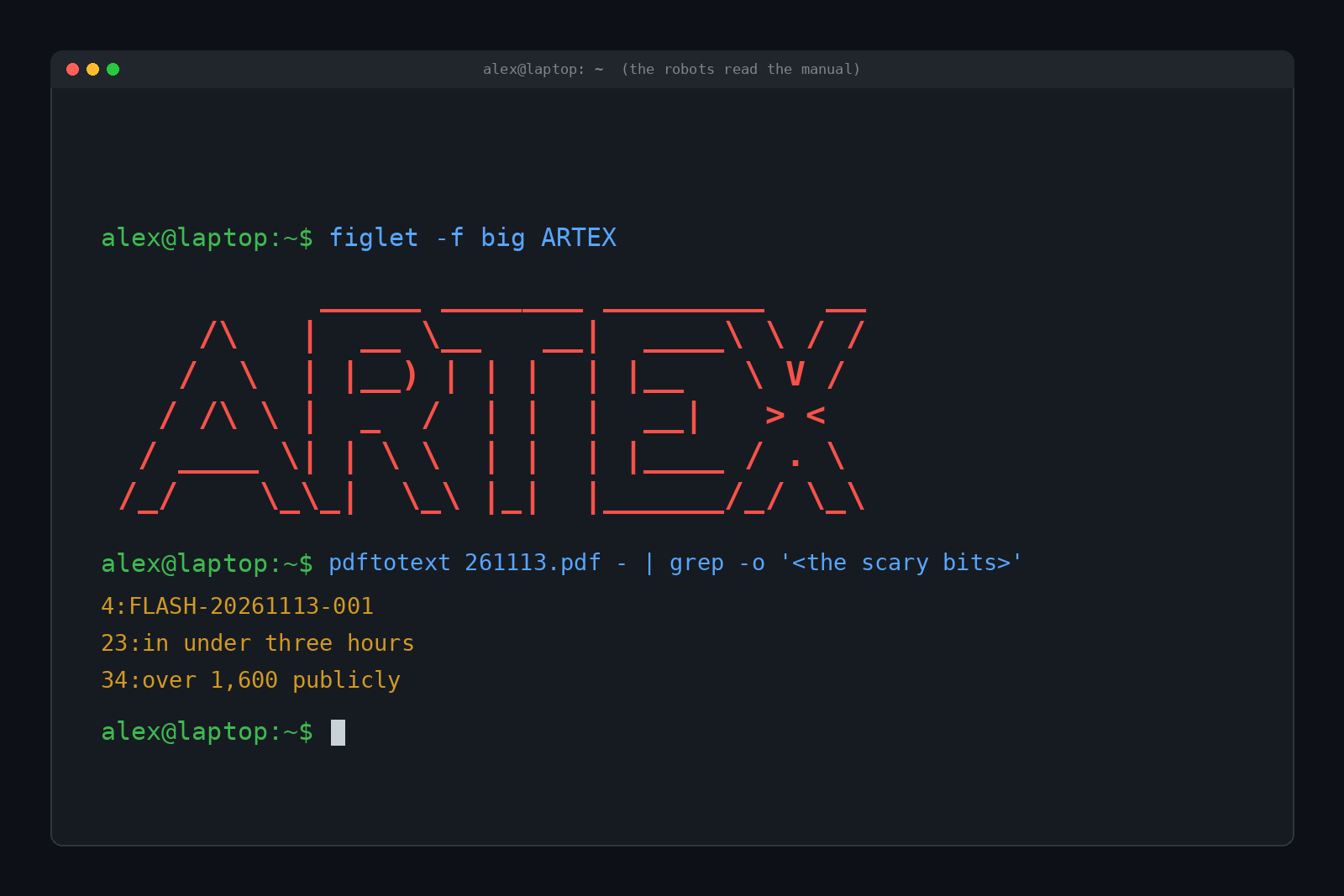
We pulled the advisory straight from the FBI's Internet Crime Complaint Center (IC3) site and checked the key lines ourselves:
Who Made ARTEX?
The FBI says ARTEX was released on GitHub in July 2026 by a developer using the handle "Autumn-27." The developer said it was meant for "authorized security testing within defined scopes" and made the repository unavailable on October 8, 2026, after reports that criminals were abusing it. According to Infosecurity Magazine, the creator also said they weren't involved in the attacks.
Here's the problem with deleting a popular open-source project: the internet already made copies. The FBI says ARTEX keeps spreading through community forks, localized versions, archived copies and a paid edition called ARTEX PRO. Taking the original down was a bit like recalling a meme.
That's the old dual-use story in security. Almost every good defensive tool can be pointed the other way. Port scanners, password crackers and exploit kits all started life as testing tools too. ARTEX just adds a layer of automation that makes the "pointed the other way" part much cheaper.
How Does ARTEX Work?
Think of it as three layers: a person with a goal, an orchestrator that breaks the goal into jobs, and a rented AI brain that figures out the commands for each job. Here's a simplified picture based on the FBI's description:
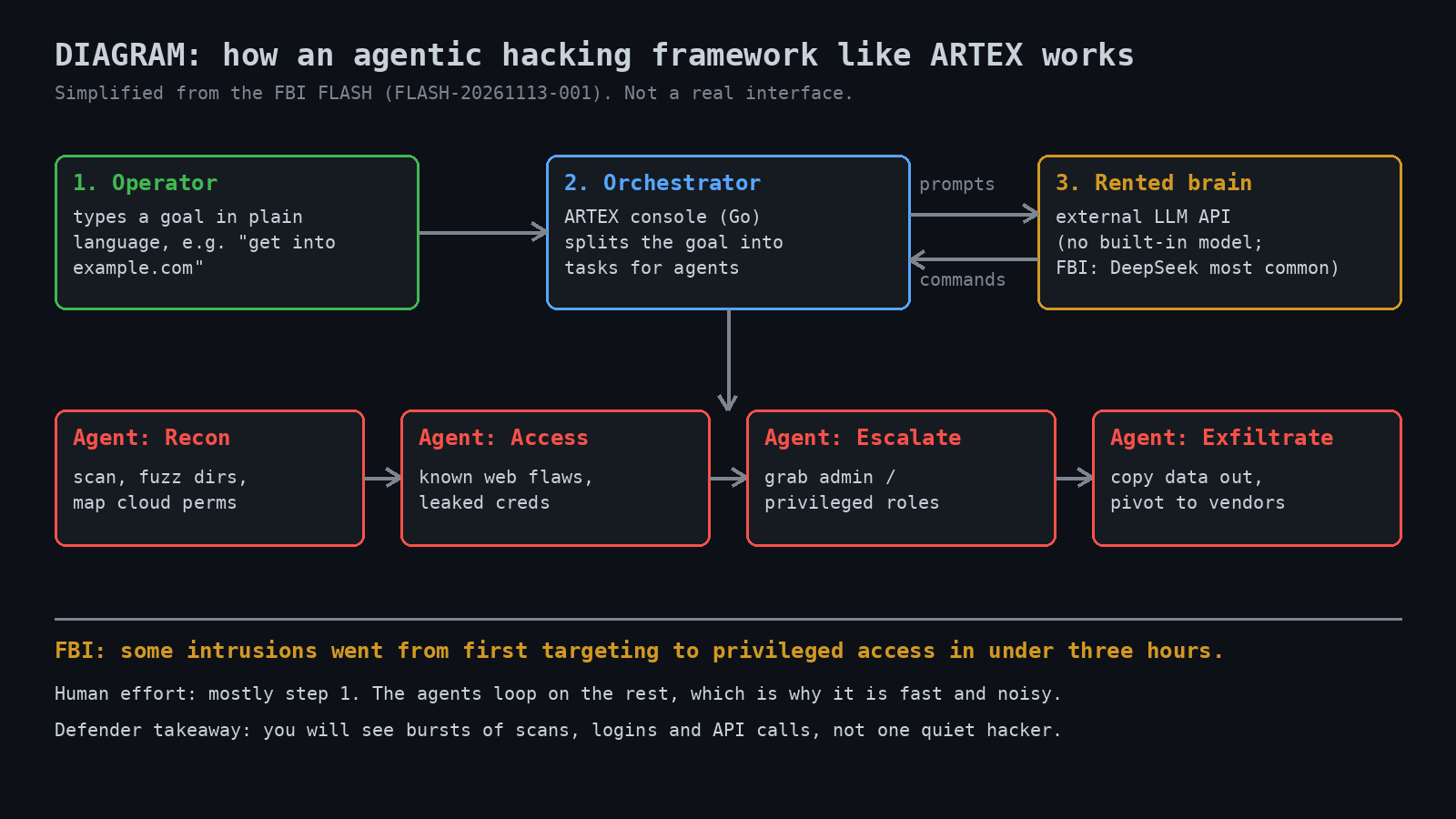
The FBI maps what it saw to the usual attack stages:
| Stage | What the agents did (per the FBI) |
|---|---|
| Recon | Fuzzed web directories across 500+ requests, mapped what stolen cloud credentials could access, ran vulnerability scans |
| Getting in | Exploited known web flaws like SSRF and XXE, abused hardcoded passwords and trusted partner accounts |
| Moving up | Went after privileged roles and admin access, sometimes in under three hours |
| Getting out | Pulled data, and in some cases pivoted from a weaker supplier into bigger customers |
Notice what's missing: brand new magic. The agents mostly found old, boring mistakes, like leaked passwords, forgotten admin pages and unpatched portals. AI didn't invent new ways in. It just checked every door at once, without getting tired or bored.
Why the FBI Is Worried
The FBI's alert boils the risk down to a few points, and they're worth reading in plain English:
- Speed. Some intrusions went from first poke to privileged access in under three hours. That's often faster than a security team can notice, meet and react.
- Scale. A small crew can run several campaigns against several targets at the same time.
- Lower skill floor. You don't need to know how to chain an exploit if the software does it for you. That's the part that keeps defenders up at night.
- The forgotten stuff gets hit. ARTEX is especially good at finding partner portals, mobile app backends, old services and little apps one department built years ago, the things nobody patches because nobody remembers they exist.
- Supply chain pivots. Break into a small vendor, then use its trusted access to reach the big customer.
The real-world numbers in the advisory back this up. The FBI ties ARTEX to attacks on South Korean financial institutions that exposed personal information on roughly 67,000 people, and to a supply chain compromise of ConnectWise Cloud Backup customers that led to attempted sign-ins to more than 2,250 downstream tenants (separate customer environments).
And the tool is easy to spot in the wild. The FBI says researchers found over 1,600 publicly exposed ARTEX consoles as of early November. Internet scanning firm Censys separately reported 1,465 exposed hosts in its own count around the same time, with a big chunk sitting on identically configured hosting, so the true number of operators is fuzzy. Some of those are surely legitimate testers. Many aren't.
Google's Threat Intelligence Group has reportedly flagged ARTEX alongside several similar agentic frameworks too, so this isn't one rogue project. It's a category.
The One Weakness: It's Noisy
Here's the good news buried in the FBI alert. ARTEX "generates high volumes of forensically noisy traffic that may trigger alerts." Agents don't sneak. They hammer. Among the warning signs the FBI lists are bursts of high-frequency, back-to-back requests against login and search pages.
That's exactly the kind of thing a boring old rate limit catches. We built a tiny fake login page on our own machine, capped it at five attempts per 10 seconds per address, and threw a script at it the way any automated tool would:
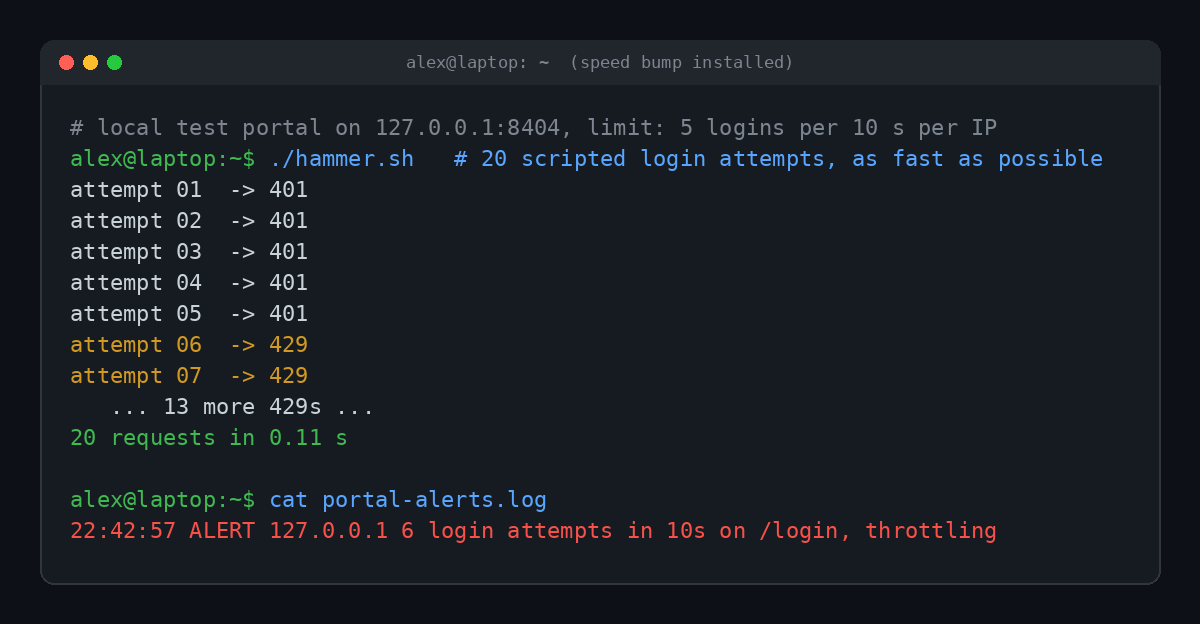
Twenty login attempts in about a tenth of a second. No human types that fast. After the fifth try the page started answering with 429 Too Many Requests and wrote an alert to the log. A real agent can slow down or rotate addresses, so a rate limit isn't a force field. But it turns a three-hour sprint into a slow, loud crawl, and that buys defenders time.
(A 429 is the server saying "slow down." Its cousin and our namesake, the 403 Forbidden error, is the server saying "no, period.")
What the FBI Recommends
For organizations, the advisory's mitigations are refreshingly unglamorous:
- Inventory everything facing the internet, including partner portals, supplier systems, mobile backends and legacy apps.
- Lock admin interfaces to trusted networks and turn off old, basic authentication where it isn't needed.
- Use least privilege for app permissions and watch for new credentials and new admin role assignments.
- Rate limit and alert on high-impact APIs, login pages and anything that returns customer records.
- Hunt for secrets in code (passwords and keys left in repositories, config files and build pipelines) and rotate anything exposed.
- Keep your logs, and preserve them before you start cleaning up an incident.
Suspicious activity can be reported to a local FBI field office or through IC3.
What ARTEX Means for Regular People
You won't get "ARTEXed" on your home laptop. This is a tool aimed at organizations. But organizations hold your data, and AI-speed attacks mean more breach notices in more inboxes.
The defenses on your side haven't changed, they've just gotten more important:
- Use unique passwords everywhere, ideally from a password manager. Agents love reused credentials. (Our post on how hackers get passwords explains why reuse is the jackpot.)
- Turn on multi-factor authentication for email, banking and anything with stored payment details.
- Take breach notices seriously. Change the affected password, watch your accounts, and consider a credit freeze if sensitive details like government ID numbers leaked.
- Be extra suspicious after a breach. Stolen personal data fuels very convincing phishing.
And if a site tells you you've been pwned, now you know the attacker may not have been a person at all.
FAQ
Is ARTEX illegal?
The software itself was published as an authorized testing tool, like many security tools. Using it against systems you don't own or have written permission to test is illegal in the US and most other countries.
Is ARTEX still available?
The original GitHub repository was taken down on October 8, 2026, but the FBI says forks, archived copies and a commercial ARTEX PRO version are still circulating.
Does ARTEX use ChatGPT or Claude?
It can connect to several outside AI services, including OpenAI's GPT and Anthropic's Claude models, according to the FBI. On attacker-run setups, the FBI saw Chinese-origin models like DeepSeek used most.
Who is ARTEX targeting?
The FBI lists financial services, government, technology, defense, semiconductor, energy, healthcare, manufacturing, telecommunications and legal organizations worldwide.
How can companies detect ARTEX attacks?
Look for bursts of rapid, automated requests against login and search pages, unexpected calls from servers to AI provider APIs, sudden new credentials or admin roles, and web shells in odd folders. The FBI FLASH lists specific indicators.
TL;DR
ARTEX is an open-source AI pen testing framework that turns a one-line goal into a full attack run by AI agents, and the FBI says criminals have used it since August 2026 to break into organizations, sometimes in under three hours. It mostly exploits old, boring mistakes at machine speed. The fixes are boring too: know what you expose, lock down admin access, rate limit logins, rotate leaked secrets, and for everyone else, unique passwords plus multi-factor authentication.