Every website you visit seems to have a little "Do Not Sell or Share My Personal Information" link buried in the footer. Clicking it on every single site would take the rest of your life. What if your browser could just say it for you, everywhere, automatically?
Short answer: that's exactly what Global Privacy Control (GPC) does. It's a setting in your browser that quietly tells every site you visit "don't sell or share my data." In at least a dozen US states, including California, Colorado and New Jersey, companies are legally required to listen. Here's how it works, where it came from, who has fought over it, and how to turn it on.
What Is Global Privacy Control?
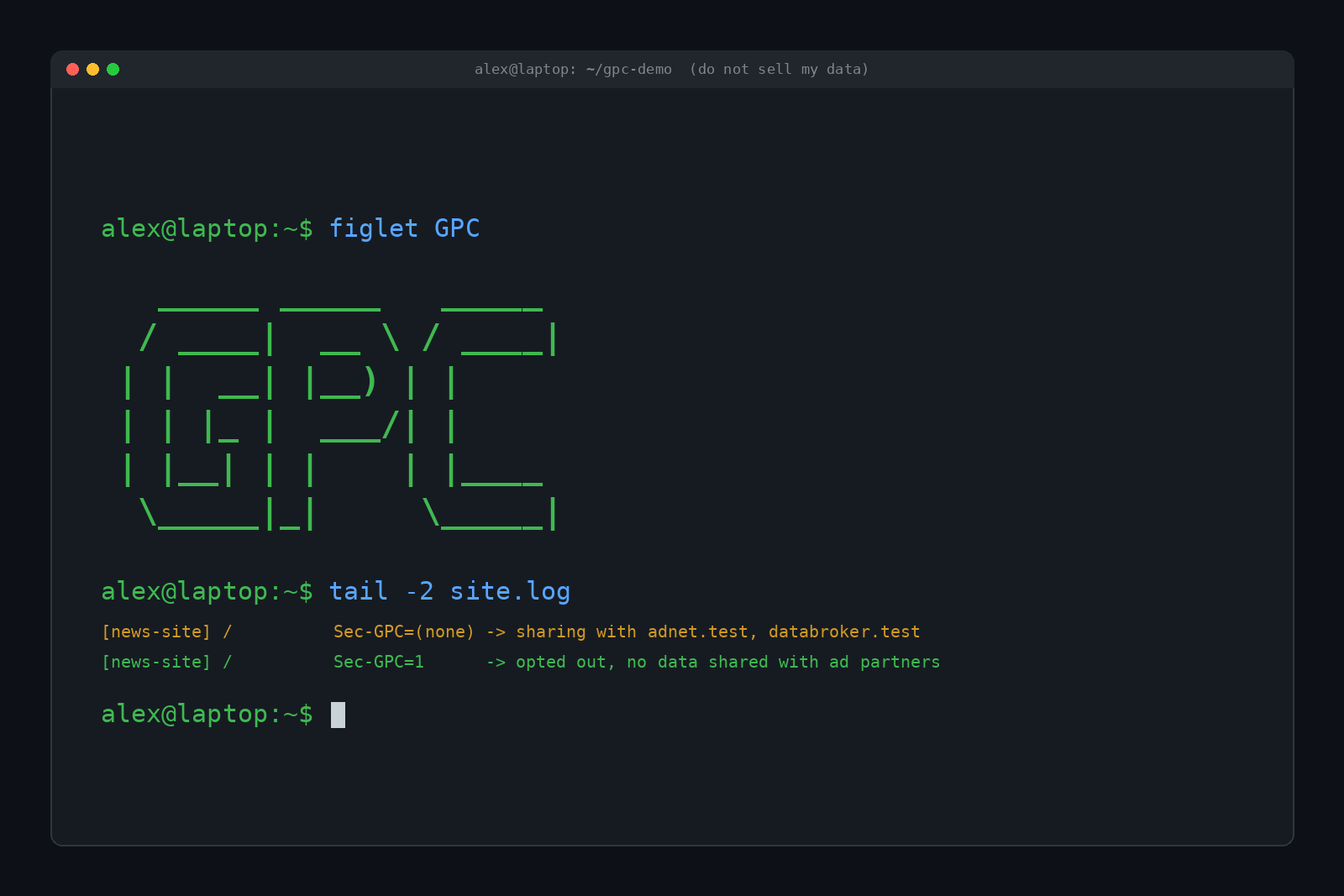
GPC is a privacy signal. When it's on, your browser attaches a tiny note to every request it makes: Sec-GPC: 1. That note means "I'm opting out of the sale or sharing of my personal information."
Think of it as a "no soliciting" sign for your data. The sign itself doesn't lock the door. What gives it teeth is the law: in states with privacy laws that recognize GPC, a business that ignores the sign is breaking the rules, the same as if you'd filled out its opt-out form and it tossed your request in the trash.
How GPC Works Under the Hood
There are three pieces, and none of them are complicated.
- The header. Your browser adds
Sec-GPC: 1to every page, image and script request. If GPC is off, the header just isn't there. - The JavaScript flag. Pages can check
navigator.globalPrivacyControl. It'struewhen GPC is on,falsewhen the browser supports it but it's off, and missing entirely when the browser doesn't support it. - The site's promise. A website can publish a small file at
/.well-known/gpc.jsonsaying whether it honors the signal.
To see what that looks like in practice, we built a tiny fake news site that does the right thing. Same page, same visitor, one header different:
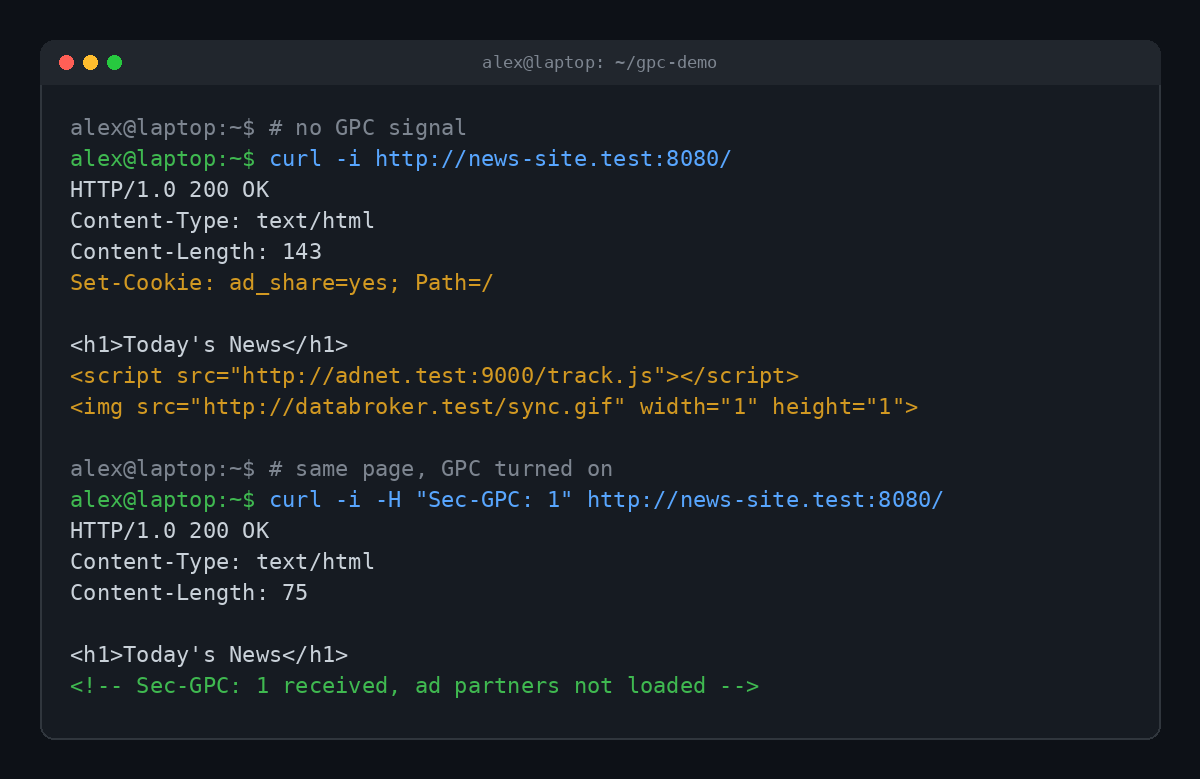
Sec-GPC: 1, it skips both.And here's the promise file a site can publish. A "gpc": true means the site says it honors the signal:
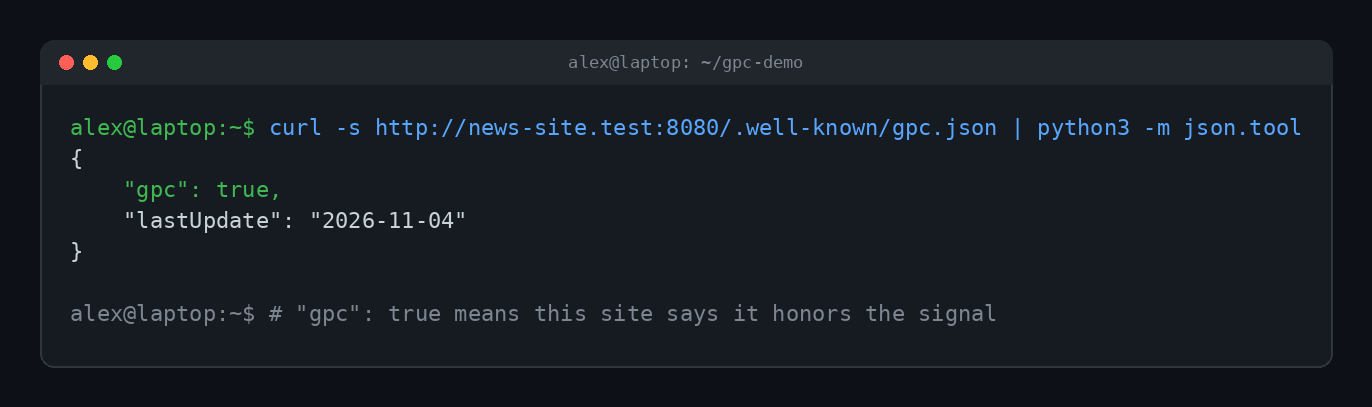
.well-known/gpc.json file from our demo site.The Backstory: Do Not Track Walked So GPC Could Run
GPC isn't the first time someone tried this. Back in 2009, researchers Christopher Soghoian and Sid Stamm built a Firefox prototype of a Do Not Track (DNT) header. The FTC endorsed the idea in 2010, and within a couple of years every major browser offered it.
So why do you still get followed around by ads? Because nothing made anyone obey it. DNT was a polite request with no law behind it, and most ad companies just ignored it. Things got messier in 2012 when Microsoft turned DNT on by default in Internet Explorer 10, and the ad industry argued that a default setting didn't reflect a real choice. One of the spec's own authors even wrote a patch for the Apache web server to ignore IE10's DNT signal.
The W3C group working on DNT shut down in 2019. Apple pulled it from Safari that same year, arguing the header was itself a data point for fingerprinting. Firefox finally removed it in early 2025 and pointed users to GPC instead.
GPC learned the big lesson: a signal is only as strong as the law behind it.
Where GPC came from
GPC was announced on October 7, 2020. It was led by Ashkan Soltani (a former FTC chief technologist, then at Georgetown Law) and Sebastian Zimmeck of Wesleyan University. The timing wasn't random. California's privacy law, the CCPA, already said businesses had to honor a browser-based opt-out signal. There just wasn't an agreed-upon signal yet. GPC filled that gap. Today the spec is being developed at the W3C, the group that sets web standards.
Who Fought for GPC
The launch list was a pretty unusual mix of privacy groups, browsers and publishers:
- Browsers and privacy tools: Brave, DuckDuckGo, Mozilla, Disconnect and Abine
- Advocacy groups: the Electronic Frontier Foundation and Consumer Reports
- Publishers: The New York Times, The Washington Post, the Financial Times, Automattic (WordPress.com and Tumblr), Glitch and Digital Content Next
Regulators turned it from an idea into an obligation. California's Attorney General confirmed that GPC counts as a valid opt-out under the CCPA, and in 2022 Sephora paid $1.2 million in the first public CCPA settlement, partly for ignoring GPC signals. In 2025, Healthline Media agreed to pay a record $1.55 million, in part for failing to honor opt-outs sent through GPC. That September, California, Colorado and Connecticut announced a joint sweep checking whether businesses actually honor GPC.
The California Privacy Protection Agency also sponsored AB 566, the "California Opt Me Out Act." Governor Newsom signed it on October 8, 2025. Starting in January 2027, every browser offered in California has to include a built-in opt-out signal like GPC. That's a first in the country.
Who Fought Against It
The pushback mostly came from the advertising industry and big business groups, and their arguments are worth hearing out.
- The money argument. The California Chamber of Commerce commissioned a report claiming easier opt-outs would cut ad spending by $3.6 billion and cost thousands of jobs. Consumer Reports pushed back, saying the report never explained its assumptions and ignored ads that don't need personal data.
- The "default isn't a choice" argument. The Network Advertising Initiative urged a veto of AB 566, arguing browsers that switch GPC on by default don't reflect what users actually want, and that this unfairly hurts ad-supported sites. (Sound familiar? Same fight as IE10 and Do Not Track.)
- The timing argument. An earlier version of the bill, AB 3048, also covered phone operating systems. Newsom vetoed it in 2024, saying he didn't want to put a mandate on OS makers yet. The 2025 version dropped phones and passed.
The biggest holdout you'll run into personally is Chrome. As of this writing, the regular version of Chrome still has no built-in GPC switch. We checked:
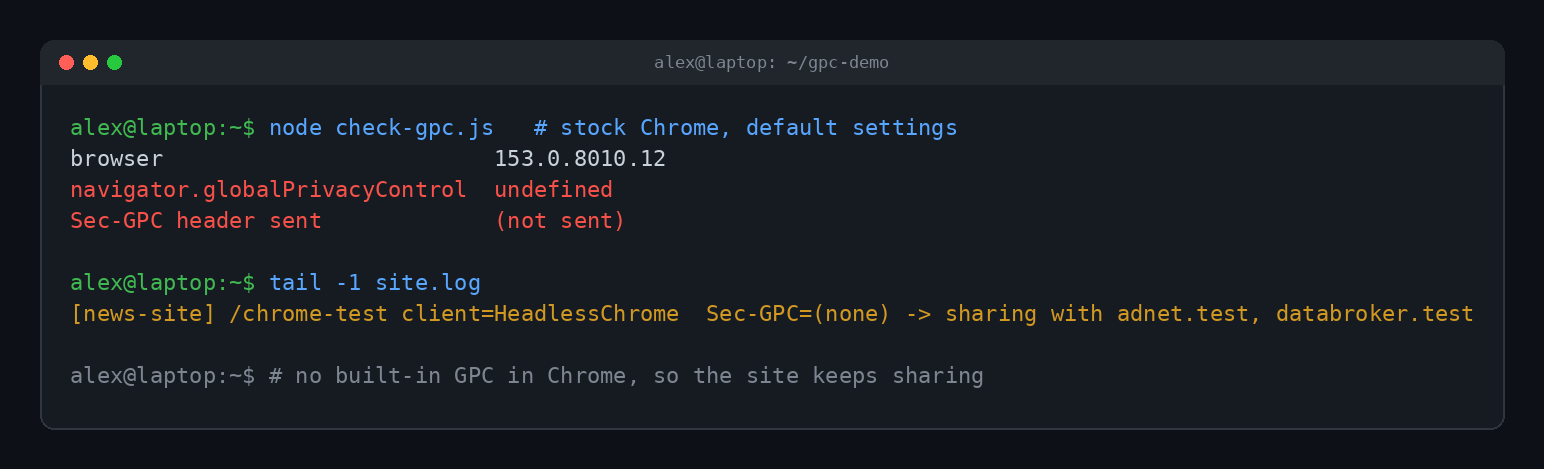
That's starting to change, probably with one eye on California's 2027 deadline. Microsoft Edge began rolling out a built-in GPC switch to US users in late October 2026. Google is testing a GPC toggle in Chrome Canary, its experimental early-release version. The code is even sitting inside the open-source Chromium browser that Chrome is built on, just switched off:
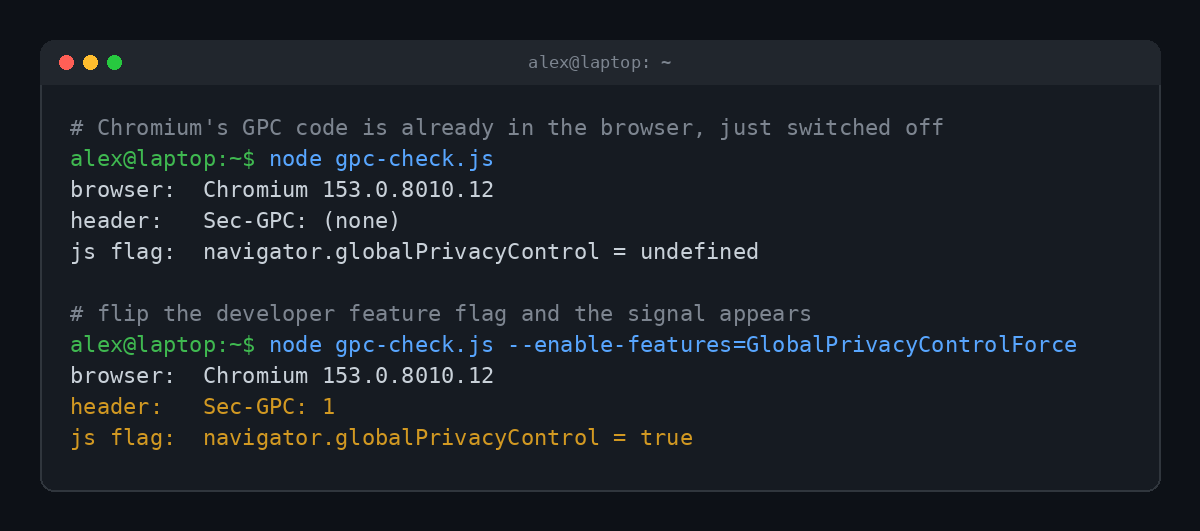
Sec-GPC: 1.Don't go flipping hidden developer flags on your everyday browser for this. Wait for the real switch, or use one of the options below.
How to Turn On Global Privacy Control
Good news: this takes about a minute, and you only do it once per browser.
Brave and DuckDuckGo
Nothing to do. Both send GPC automatically, on desktop and mobile.
Firefox
- Open the menu (three lines, top right) and pick Settings.
- Click Privacy & Security.
- Check Tell websites not to sell or share my data.
Firefox already sends GPC in private windows by default. Firefox for Android has the same option in its privacy settings.
Microsoft Edge
- Open the menu (three dots, top right) and pick Settings.
- Click Privacy, search, and services.
- Under Privacy, turn on Global Privacy Control.
The switch is rolling out to US users first, so if you don't see it yet, update Edge or use one of the extensions in the Chrome section for now.
Chrome
No built-in option yet, so add an extension that sends the signal. The EFF's Privacy Badger and the DuckDuckGo Privacy Essentials extension both send GPC by default, and they block a lot of trackers too.
Safari, iPhone and iPad
Safari doesn't support GPC natively. On an iPhone or iPad, the easiest fix is browsing with the DuckDuckGo or Brave app, which send it automatically.
Check that it's working
Visit globalprivacycontrol.org. The bar across the top of the page tells you whether it detects your signal:
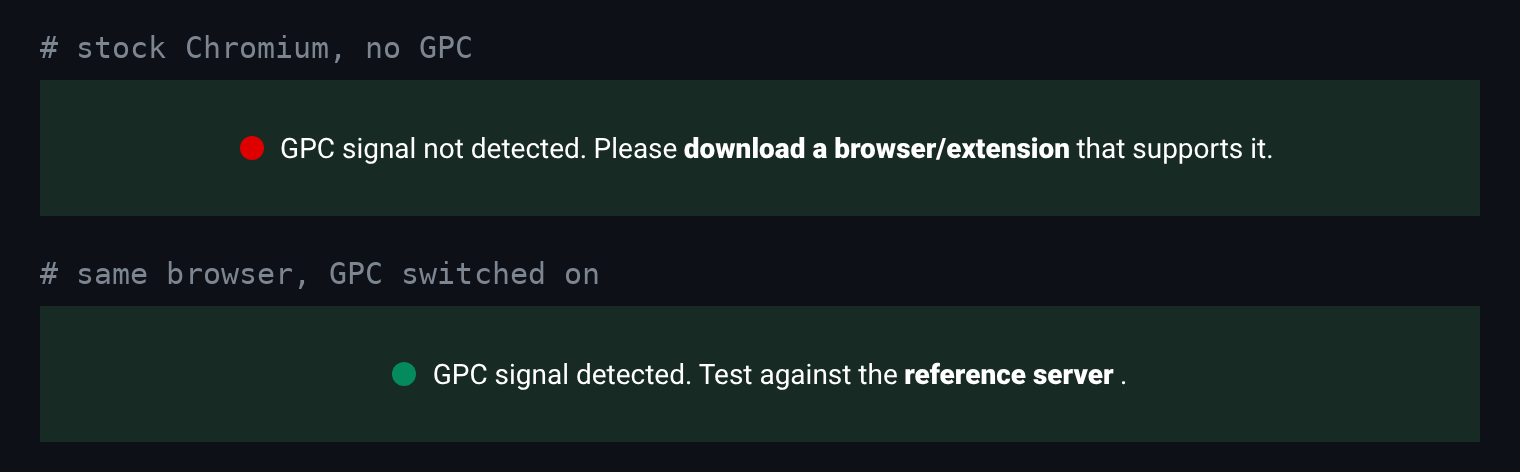
If you like poking around, open your browser's developer console (F12 on Windows) and type navigator.globalPrivacyControl. You want to see true.
What GPC Does and Doesn't Do
GPC is great, but it's not an invisibility cloak.
- It does legally opt you out of the sale or sharing of your data, including for targeted ads, on sites covered by state laws that recognize it.
- It doesn't block trackers by itself. A site that ignores the law can still track you, which is why pairing GPC with a tracker blocker makes sense. (Here's how websites track you in the first place.)
- It doesn't hide your IP address or stop logins from identifying you. (For that side of things, see our post on whether a VPN actually keeps you anonymous.)
- It doesn't delete data a company already has. That takes a separate deletion request.
Outside the states with these laws, GPC is still a polite request, just like DNT was. Plenty of sites honor it everywhere anyway because it's easier than checking where you live.
Quick Answers
Is Global Privacy Control legally binding?
In at least a dozen US states, including California, Colorado, Connecticut, Texas and New Jersey, yes. Covered businesses must treat it as a valid opt-out of selling or sharing your data.
Is GPC the same as Do Not Track?
Same idea, different outcome. Do Not Track had no law behind it and was widely ignored. GPC is written into state privacy laws and regulators enforce it.
Will GPC break websites?
No. It's just a header. Sites load normally; they're simply supposed to stop selling or sharing your data.
Does Chrome support GPC?
Not in the regular version yet. Google is testing a switch in Chrome Canary, and Edge has started rolling one out in the US. Until Chrome ships it, use an extension like Privacy Badger or DuckDuckGo Privacy Essentials. California's new law requires browsers there to offer an opt-out signal starting in 2027.
Do I still need to click "Reject all" on cookie banners?
It helps. GPC covers selling and sharing under US state laws, but cookie banners also cover things like analytics, and some sites only check the banner.
TL;DR
Global Privacy Control is a browser setting that tells every site "don't sell or share my data," and in at least a dozen US states that request is legally binding. It's on by default in Brave and DuckDuckGo, one checkbox away in Firefox, rolling out as a built-in switch in Edge, and an extension away in Chrome. Turn it on once and every site you visit hears your opt-out. (Whether they listen is now a legal question, not a polite one.)